
2020 is a key year for the comprehensive deepening of reforms in my country’s capital market. This year, with the rapid advancement of the GEM registration system, the implementation of the selected layers of the New Third Board’s deepening reform, and the gradual maturity and improvement of the Science and Technology Innovation Board in the second year of listing, China’s capital market has entered a new stage of deepening reform and steady development. Over the past year, a total of 396 companies have completed initial listings and entered the Shanghai and Shenzhen markets. The amount of IPO funds raised reached 472.513 billion yuan, a record high in the past ten years.
As a pillar industry of the national economy, an important national livelihood industry and the traditional industry with the most internationally competitive advantages, textile and clothing companies have also entered an intensive period of “listing” in 2020. Relevant statistics show that the number of IPO listings and fund-raising scale of textile and apparel companies increased rapidly throughout the year. A total of 18 new stocks were listed throughout the year, accounting for 4.55% of the annual IPO companies, which was the fastest growth rate in the past two decades. The initial IPO funds raised reached 19.6 billion yuan, accounting for 4.15% of the annual IPO funds raised by A-shares, a significant increase of 2.18 percentage points from the 1.97% of the previous year.
1. From the perspective of subdivided professional fields, the textile and apparel listed financing companies this year are mainly chemical fiber manufacturing, clothing and apparel and industrial textiles. Among them, chemical fiber manufacturing companies accounted for 33.33%, industrial textile companies 27.78%, and clothing and apparel companies 22.22%. The number of listed companies in these three professional fields accounts for 83.33% of the entire newly listed textile and apparel companies. The professional classification of 18 newly listed textile and apparel companies in 2020 and the listing status of textile and apparel companies in recent years are as follows in Table 1 and Figure 1.
2. Judging from the initial financing scale of the 15 newly listed textile and apparel companies throughout the year, Cathay Biologics (688065.SH), Wenjian Medical (300888.SZ) and Haoyue Care (605009.SH) ranked among the top three . Among them, Cathay Biologics (688065.SH) and Winner Medical (300888.SZ) accounted for more than 50% of the IPO funds raised, 30.29% and 20.23% respectively. The following is a detailed list of the initial financing of 18 newly listed textile and apparel companies in 2020:
Textile and apparel categories in recent years The comparison of the capital raising situation of enterprises in Shanghai and Shenzhen stock exchanges is as follows:
3. Textile and clothing categories in 2020 The geographical distribution of corporate IPO listings (see Figure 3 and Table 3 below). Zhejiang, Jiangsu, Shandong, and Guangdong are the first echelon of IPOs for textile and apparel companies in 2020, and Anhui, Shanghai, and Fujian each have one company listed. (Note: There is a clothing company in Beijing that has not passed the meeting in 2020 and has not been approved for listing)
4. Regarding whether the initial public meeting of enterprises in 2020 has passed or whether the IPO review has been rejected
According to relevant information from the China Securities Regulatory Commission , a total of 620 companies were listed on the IPO (A shares) in 2020, including 124 on the main board, 59 on the small and medium-sized board, 213 on the GEM, and 224 on the science and technology innovation board. Judging from the review results of the previous meeting, 9 were rejected and 6 were postponed. The approval rate is as high as 97.58%, the highest in history. Judging from the pass rate of each sector, the main board has the highest pass rate at 99.19%; the small and medium-sized board has the lowest pass rate at 91.53%; the GEM and Science and Technology Innovation Board have the pass rates of 98.59% and 97.32% respectively.
The 9 rejected companies include 1 on the main board, 4 on the small and medium-sized board, 2 on the GEM, and 2 on the science and technology innovation board. The four companies that were rejected by the small and medium-sized board include Beijing Jiaman Clothing Co., Ltd., a company in this industry.
After research, Beijing Jiaman Clothing Co., Ltd. is a company whose business covers mid-to-high-end children’s clothing design, supply chain management, operations promotion, direct sales and franchise sales and other core businesses. A children’s clothing (mid-to-high-end) brand management and operation company targeting middle- and high-income groups. The company operates more than 20 brands, including its own brands, authorized brands, international retail agency brands, etc. Including self-owned or authorized brands such as Shuihaier, Haggis, and Hush Pushi, as well as more than 20 international brands such as KENZO KIDS, HUGO BOSS, and FENDI.
Financial statement data shows that the company’s revenue and profits have grown rapidly since 2015, and its economic benefits and brand market influence have increased significantly. But at the same time, inventory levels also increased significantly, significantly higher than the industry average for the same period. Figures 4 and 5 below show the inventory proportion, revenue, and net profit of Beijing Jiaman Clothing Co., Ltd. from 2015 to the first half of 2018 (data source: “Prospectus”).
According to the Tenth Announcement of the China Securities Regulatory Commission on January 9, 2020 Announcement of the review results of the 10th meeting of the Eighth Issuance Review Committee in 2020, including imperfect internal control of fixed assets, the reasons and rationality for the growth of operating income, the sustainability and stability of cooperation with relevant brands, and the rationality of large inventory balances Four issues including Beijing Jiaman Clothing Co., Ltd.’s IPO failed to pass the review. In summary, the most important issues are the company’s core competitiveness and sustainable operating capabilities. For example, questioning the company’s proportion of operating income from authorized brands Problems with revenue and profit growth such as year-on-year growth and the decline in the proportion of private-label revenue are posing problems; the company has not signed long-term cooperation agreements with most international brands, and the company’s inventory balance is large and growing rapidly, and the rationality of impairment provisions is And there are many differences with the average value of the same industry (comparable companies) and other issues with the company’s sustainable operating capabilities. Clothing and apparel companies generally have the characteristics of fierce homogeneous competition and weak bargaining power. During the IPO review process, it is inevitable to Important financial data such as revenue, net profit and inventory are of great concern, which is also the main reason why many clothing and apparel companies have failed to pass IPO review in recent years.
5. Regarding the situation of newly listed textile and apparel companies on the National Equities Exchange and Quotations in 2020
2020 is a very critical advancement for the National Equities Exchange and Quotations to deepen the reform of the New Third Board. year. In this year, the “New OTC Market” was further subdivided into the basic layer, the innovative layer and the selected layer. The successful opening of the selected layer is not only a milestone in the development of the New OTC Board, but also the starting point for further deepening.
According to statistics, in 2020, 181 NEEQ “transfer” companies made their debut, of which 171 passed, 4 canceled the review, 4 suspended voting, and 2 failed. Passed The rate is 94.48%.
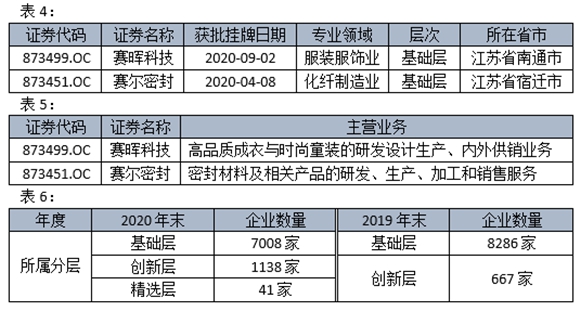
The number of newly listed companies during the year reached 135. Among them, 2 textile and clothing companies passed the review and listing (Table 4 and Table 5 below). They will be delisted in 2020 There are 903 enterprises; the number of enterprises in the selected layer has reached 41, and the number of enterprises in the innovation layer has increased to more than 1,000 (Table 6 below).
</p